The Complete Leather Furniture
Care & Maintenance Guide
How to clean, condition, and protect fine leather furniture, including the cowhide, exotic hides, and tooled leathers that most care guides never mention.
The Short Answer
How Should Leather Furniture Be Cared For?
How Should Leather Furniture Be Cared For?
Identify the leather or hide before you touch it with anything. Dust and vacuum regularly, working into seams and crevices. Use only cleaners compatible with that specific leather and finish. Condition smooth, conditionable leathers sparingly, roughly every four to six months, and only when the leather actually needs it. Keep the piece away from direct sunlight, fireplaces, and heat vents, and stay aware of body oils and abrasion at the points you touch most.
Treat hair-on-hide, suede, and specialty materials differently from smooth leather; most should never receive standard leather conditioner at all. And when you are not certain what a surface is, stop before experimenting. On fine leather the greater risk is rarely the stain. It is what an untested product does to the finish while you are trying to remove it.
Start Here
Before You Clean Anything: Know What You're Caring For
Most of the damage we are asked to repair came from a product that was fine in itself, just used on a material it was never meant for. These three questions tell you what you are actually working with.
Is It Smooth Leather or Hair-on-Hide?
This is the single most important distinction on the page, because the two are cared for by opposite rules. Smooth leather is a finished surface you can clean and, in most cases, condition. Hair-on-hide is hair still attached to the skin, and it responds badly to moisture, rubbing, and conditioner.
Run your hand across it. If there is a nap with a direction to it, treat it as hide, not leather.
What Finish Does the Smooth Leather Have?
Finish determines what a cleaner will do. Protected or pigmented leather has a surface coating and is the most forgiving. Aniline and semi-aniline are dyed through with little or no topcoat, so they absorb readily and mark easily. Pull-up and distressed leathers are designed to lighten and shift as they flex. Suede and nubuck are napped and take no standard conditioner at all.
If you cannot name the finish, our Leather Types Guide walks through identification in detail.
Does the Piece Contain More Than One Material?
On Western furniture the answer is usually yes. A single chair may combine smooth leather, hair-on-hide, tooled or embossed panels, suede, carved wood, nailhead trim, and metal hardware.
Each of those wants different treatment, and a product that is perfectly safe on one can permanently mark another. Identify every surface on the piece before you begin, not just the one with the mark on it.
"If you don't know the leather or the finish, don't experiment with a cleaner." The most common mistakes we see are harsh household cleaners that dry the leather and cause cracking, and leather-care products that simply aren't suited to that specific type of leather.
The Difference
Why Western Leather Furniture Requires Different Care
A conventional leather sofa is one material with one finish. That is what generic leather-care advice is written for, and it is why so much of that advice fails on a Western piece.


Tap or click any material above to see it full size.
Quick Reference
The Runyon's Leather & Hide Care Chart
Find your material, then read across. Everything below this chart explains the reasoning in detail.
| Material | Routine care | Conditioner? | Biggest risk | Call a professional when |
|---|---|---|---|---|
| Protected / pigmented leather | Dust and vacuum; wipe with a barely damp cloth; dry naturally. | Yesevery 4–6 months | Finish wear at high-contact points; buildup of body oils. | Finish is peeling, cracking, or has lost colour in patches. |
| Pure aniline (unprotected) | Dust and vacuum; blot spills immediately; avoid water. | Yesevery 3–6 months, or every 1–3 in hot, dry, or sunny conditions | No protective coating, so it absorbs liquid and oil readily. | Any liquid has soaked in, or a spot has darkened permanently. |
| Semi-aniline (protected) | Dust and vacuum; wipe with a barely damp cloth. | Yesevery 4–6 months, or every 3–4 with sun exposure or dry air | Marks more readily than fully pigmented leather. | Staining has set, or the light topcoat is wearing through. |
| Pull-up / distressed | Dust and vacuum; expect tone to shift as it flexes. | Noconditioner darkens it and softens the pull-up effect | Routine conditioning, which flattens the character it is built for. | Cracking appears in the grain rather than surface marking. |
| Suede / nubuck | Vacuum, then dry-brush with a soft suede brush. No water or liquid cleaners. | Nowe do not recommend a conditioner on suede or nubuck | Water spotting; oil staining; crushed or matted nap. | Any oil or liquid stain, at all. Do not attempt this yourself. |
| Cowhide (hair-on) | Vacuum gently in the direction of the hair; leave it alone otherwise. | Nonever on the hair | Hair loss from friction. The most common cowhide issue we see. | Hair is shedding, thinning, or the hide is lifting at an edge. |
| Axis deer hide | Vacuum gently with the hair; keep dry. | Nonever on the hair | Moisture and rubbing; spotted hair does not grow back. | Anything beyond surface dust. Ask before treating it. |
| Springbok hide | Vacuum gently with the hair; keep dry. | Nonever on the hair | Short, fine hair is easily abraded and cannot be replaced. | Any staining, matting, or hair loss. |
| Buffalo leather (smooth) | Treat as smooth leather; dust and wipe gently. | Dependson the finish applied | Confusing it with buffalo hair-on hide, which is different. | You are unsure which of the two surfaces you have. |
| Buffalo / bison hair-on | Vacuum gently with the hair; keep dry. | Nonever on the hair | Moisture matting the dense curl permanently. | Matting, staining, or odour that vacuuming does not resolve. |
| Tibetan lamb / shearling | Shake out and vacuum on the lowest setting; separate curls by hand. | Nonever on the wool | Water and heat, which shrink and matt the curl. | Any wet spill, matting, or discolouration. |
| Tooled leather | Wipe with a damp cloth; dust the recesses with a soft dry brush. | Ask firstcontact us before treating or conditioning | Product pooling in the tooling and drying lighter or darker. | Residue has collected in the relief, or colour has shifted. |
| Embossed leather (croc, gator, ostrich) | Wipe with a damp cloth; dust the pattern with a soft dry brush. | Ask firstcontact us before treating or conditioning | Cleaner trapped in the pattern; wear on the raised edges. | The embossed pattern is losing definition or colour. |
Scroll the chart sideways to see every column →
Where a leather is both aniline and pull-up or distressed, follow the pull-up row: we do not recommend routine conditioning on those finishes.
Where this chart says ask first or depends, that is not hedging. Finishes vary between hides and between pieces, and the only reliable answer is the one specific to the piece you own. Send us photographs and we will tell you what it is and what it needs.
Everyday Care
Routine Care and How to Clean Leather Safely
Most leather furniture needs far less intervention than people assume. Regular dusting prevents more damage than any cleaner ever repairs.
Routine care is dusting and gentle vacuuming, with attention to seams and crevices where grit collects. Grit is abrasive; left in a seam it works against the leather every time someone sits down. A soft brush attachment on low suction is enough.
Periodic inspection matters more than a rigid schedule. Look for body-oil buildup, dryness, colour change, abrasion, hair loss, finish wear, loose stitching, and excessive friction where a mechanism moves. Catching any of these early is the difference between maintenance and repair. Clean when the piece needs cleaning rather than on an arbitrary calendar.
The Safest Cleaning Sequence
Check the material and any care instructions that came with the piece.
Remove loose debris by dusting and vacuuming first, so you are not grinding grit into the surface.
Test any product in a hidden area and let it dry fully before judging the result.
Use the least aggressive method that could work, not the strongest one available.
Work in small areas so you can stop the moment something looks wrong.
Never saturate the leather. Damp, never wet.
Allow it to dry naturally, away from heat, sunlight, and hairdryers.
Evaluate the dry result before applying anything else.
What a Spot Test Is Actually Looking For
Colour transferring onto your cloth. Darkening or lightening. A change in sheen, so the tested patch no longer matches. Tackiness once dry. A change in texture. Any sign the finish itself is lifting. If you see any of these, that product is wrong for that leather, and the answer is to stop rather than to scrub harder.
Cleaning the Details Western Furniture Actually Has
Tufting & deep seams
They trap dust and hold liquid far longer than a flat panel. Vacuum them out rather than wiping.
Tooling & embossing
Recesses pool any product you apply and dry a different shade. Brush them out dry instead.
Decorative stitching
Work around it rather than over it. Thread holds moisture and shows soiling first.
Nailheads & buttons
Dust around them, never soak. Moisture sitting against metal marks the leather beneath.
Leather meeting wood
Work each surface up to the join, never across it. The two finishes are not compatible.
Recliner creases
Open the piece out, clean the hidden leather, and let it dry fully before closing it again.
Conditioning
How and When to Condition Leather Furniture
Does All Leather Furniture Need Conditioner?
No. Conditioner is for smooth, conditionable leather. Do not condition hair-on hides, suede, or nubuck. We also do not recommend routine conditioning on pull-up and distressed leather, because it darkens the surface and softens the very effect those leathers are made for. On tooled and embossed leather, ask us before treating it at all.
As a general rule Runyon's recommends conditioning smooth leather every four to six months, though the right interval varies with the leather type, the environment, and how hard the piece is used. Pure aniline in a hot, dry, or sunny room may want it as often as every one to three months. Whatever the schedule, condition sooner if the leather begins to feel noticeably dry, stiff, or rough. The care chart gives the interval for each leather individually.
Signs Leather May Actually Need Conditioning
The leather feels dry, stiff, or noticeably less supple than it used to. That is the signal. Changes in colour, markings, and character are usually normal patina developing with use, not dryness, and conditioning in response to those will not restore anything.
Applying It Correctly
Clean and fully dry the piece first, or you will seal dirt into the leather. Test in a hidden spot. Apply a thin, even coat with a soft cloth rather than working it in heavily, and cover the whole panel rather than spot-treating, so you do not create a patch that reads differently. Let it absorb, then buff off whatever has not been taken up. This applies to smooth conditionable leather only; see the chart before treating anything else.
What Over-Conditioning Looks Like
A surface that stays tacky rather than drying. A greasy sheen that attracts dust and transfers onto clothing. Leather that has gone limp instead of supple, or darkened unevenly where the product pooled. More conditioner does not produce better leather, and over-conditioning is harder to undo than under-conditioning.
One of the biggest misconceptions is that any DIY or household solution is safe on leather. Saddle soap, furniture polish, cooking and household oils, and alcohol-based cleaners can all damage certain types of leather. Use a product made for your leather type and follow the manufacturer's instructions.
Prevention
The Biggest Causes of Damage to Fine Leather Furniture
The areas with the most contact show wear first: seats, armrests, headrests, and edges. Almost everything below is preventable with placement and habit rather than product.
Body Oils and Perspiration
The most underestimated cause of wear on expensive leather. Oils transfer every time skin meets leather and accumulate invisibly for months before they show as a darkened, slightly tacky patch.
Recliner headrests are the classic example, along with armrests, desk chairs, and whichever seat someone in the house has claimed as theirs. Regular light dusting removes oils before they set; once absorbed they are a professional job.
Sunlight, Fireplaces, and Dry Air
Keep leather away from direct sunlight and from heat sources including fireplaces and heating or AC vents. Prolonged exposure dries leather out, fades it, and eventually cracks it, and none of that is reversible.
This matters more for our clients than for most. Ranch homes tend to have large windows, intense sun, working fireplaces, and dry regional air, and vacation properties add long unoccupied stretches with the blinds open. Rotate cushions, use window treatments during peak sun, and keep pieces off the fireplace wall.
Denim, Hardware, and Friction
Dark denim transfers dye into light leather, and on aniline or unprotected finishes that transfer can be permanent. Belt buckles, jean rivets, jewellery, decorative hardware, and boots all scratch or abrade a surface faster than daily use ever will.
Then there is repeated friction, which concentrates at recliner footrests, seat fronts, swivel chairs, and saddle stools. On hair-on-hide surfaces that same friction removes hair, and hair does not grow back. Pets add claws to the same list.
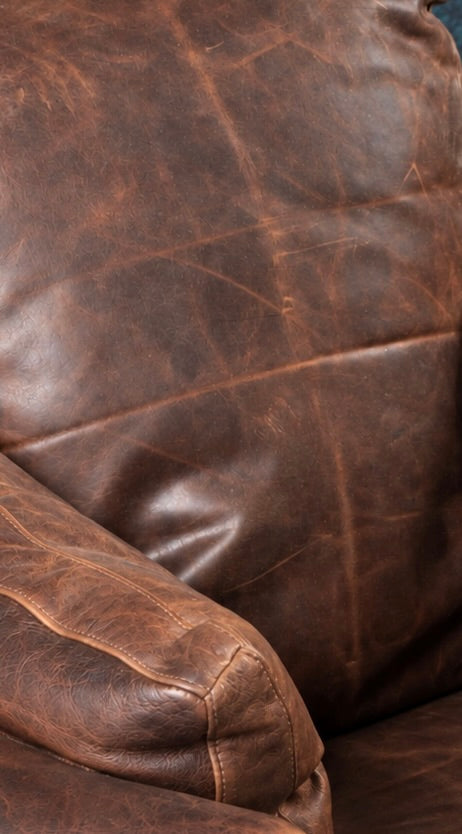
Across everything our service team sees, the damage that comes up most often is staining, scratches, and damage caused by using the wrong leather cleaner or conditioner.
Two of those three are accidents. The third is avoidable entirely, which is why so much of this guide is about identifying the material before reaching for a product.
Incidents
What to Do When Something Spills on Leather
Speed matters more than technique. Blot immediately with a clean dry cloth, working inward from the edge, and never rub.
Water and Clear Liquids
Blot immediately and let the area dry naturally and slowly. Resist the urge to speed it with heat, which is what actually causes the stiffness and cracking people blame on the water. On aniline and unprotected leathers even clean water can leave a ring, so blot the whole panel rather than the spot alone.
Food and Beverages
Lift solids away with something blunt rather than scraping. Blot liquid, then treat as water above. Anything with pigment behind it, red wine, coffee, fruit juice, is a timing problem: on protected leather prompt blotting usually resolves it, while on aniline it may not be recoverable at home at all.
Grease, Oils, and Body Oils
Do not add liquid, which spreads the oil outward and enlarges the mark. Blot what sits on the surface. Oil that has already absorbed is a professional job on any leather, and attempting to draw it out with household absorbents or solvents usually leaves a lightened halo that is more visible than the original stain.
Ink, Marker, and Dye Transfer
The category most often made permanently worse by a first attempt. The alcohol-based removers circulated online strip finish along with pigment, leaving a pale patch where the ink was. Blot fresh ink, then stop. Denim dye transfer is the common version of this and responds far better to professional treatment than to experimentation.
Pet Accidents
Blot thoroughly and quickly, because the issue is absorption into the hide rather than the surface mark. Avoid enzyme cleaners and disinfectants formulated for carpet; they are far too aggressive for finished leather. On hair-on-hide, treat any pet accident as a call rather than a clean-up.
Wax, Gum, and Sticky Substances
Let it harden completely before touching it. Lift gently rather than pulling, since pulling takes finish with it. Never apply heat to soften wax on leather, and never use solvents to dissolve adhesive residue. What remains after gentle lifting is worth leaving to someone with the right materials.
When to Stop Cleaning
Stop immediately and contact a professional if any of the following happens. Continuing past these signs is what turns a stain into a repair.
- Colour is transferring onto your cloth
- The finish is changing or lifting
- The stain is spreading outward
- The leather is darkening rapidly
- You do not know what the material is
- Hair-on-hide is involved
- Suede or nubuck is involved
- The cleaner has left a tacky surface
Hair-on-Hide
Caring for Cowhide and Hair-on-Hide Furniture
This is where most leather-care advice stops being useful, and where the wrong instinct causes the most permanent damage.
Hair-on-Hide Is Not Cared For Like Smooth Leather
Runyon's recommendation is to avoid cleaning or treating hair-on-hide areas unless it is genuinely necessary. When care is needed, handle the surface gently and avoid harsh cleaners, leather conditioners, excessive moisture, and aggressive rubbing, all of which damage the hair and the hide beneath it.
The reason is simple: on smooth leather the surface can often be corrected. On hair-on-hide, hair that has been abraded away, matted, or chemically stripped does not come back.


Everyday Cowhide Care
Vacuum gently, on a low setting, always in the direction the hair lies. Going against the nap lifts and loosens hair at the root. Where debris needs more than suction, brush in the direction of the hair with a soft, clean bristle brush. If an area genuinely needs cleaning, wipe with a barely moist soft cloth, again moving with the hair, and let it dry naturally. Shake out loose hides outdoors rather than beating them. Beyond that, the best care is leaving it alone.
Handling Spills on Hide
Blot straight away with a dry cloth, pressing rather than wiping, and let it air dry completely away from heat. Do not soak, do not scrub, and do not reach for a leather cleaner. If anything beyond clean water has gone into the hair, that is the point to ask rather than improvise.
Preventing Hair Loss and Bald Spots
Hair loss on hide is almost always friction rather than age. It appears first where a piece is touched constantly: seat fronts, the outer edge of an arm, the pivot area of a swivel chair, and the top of a saddle stool. Rotating cushions where the design allows, and simply being conscious of belt buckles and rivets against hide panels, prevents most of it.
Can You Condition Cowhide?
Not the hair-on surface, and not with ordinary leather conditioner. Conditioner is formulated to be absorbed by a finished leather surface. Applied to hair it coats and weighs down the strands, attracts dust, matts the nap, and leaves a greasy sheen that is difficult to reverse. The smooth leather elsewhere on the same piece may well need conditioning. The hide does not.
Pieces That Combine Leather and Cowhide
This is the common case in our collection rather than the exception, and it is where care goes wrong most often. Treat each material separately and be careful not to let leather cleaner or conditioner reach the hide, the wood, or the nailheads. Work the leather sections with the piece positioned so nothing runs downhill onto hide, and keep your cloth barely damp so there is nothing to run.
The damage we are asked about most on hair-on-hide comes from treating it like leather: a conditioner applied to the hair, a cleaner that soaked in, or vigorous rubbing at a mark. Gentle handling and restraint preserve a hide far longer than any product will.
Specialty Materials
Caring for Exotic Hides and Specialty Upholstery
Each of these behaves differently. The pattern below is the same for all of them: routine care, the biggest risk, what never to use, and when to ask.
Axis Deer Hide
Vacuum gently with the hair and keep it dry. The distinctive white spotting is the hair itself, not a printed pattern, so abrasion that removes hair removes the marking permanently and visibly. Never use leather conditioner, solvent, or water beyond blotting. Ask before treating anything more than surface dust. Browse the axis hide collection.
Springbok Hide
Springbok has a shorter, finer, tighter coat than axis, which makes it feel more robust and actually leaves it more vulnerable to abrasion. Vacuum gently with the hair, keep it dry, and keep it away from high-friction contact points. Never condition it. See the springbok collection.
Buffalo Leather and Buffalo Hide
These are materially different surfaces and the same word covers both. Buffalo leather is a smooth, finished, heavily-grained leather that is cared for like any other smooth leather, conditioner included, depending on its finish. Buffalo or bison hair-on hide is a dense curled coat that must never be conditioned and must be kept dry. Establish which one you have before doing anything. Browse buffalo pieces.
Tibetan Lamb and Shearling
Long-curl Tibetan lamb and dense shearling fleece are both wool on hide and both hate water and heat, which shrink and matt the curl irreversibly. Shake out, vacuum on the lowest setting, and separate matted curls gently by hand rather than brushing them. Any wet spill is a professional matter. See the Tibetan lamb collection.
Suede and Nubuck
Napped leather with no protective topcoat, which makes it the least forgiving surface in the house. Vacuum, then dry-brush with a soft suede brush using small circular motions to lift dust and keep the nap even. Never use water, liquid cleaner, or conditioner. Any oil or liquid staining should go straight to a professional, because home attempts almost always leave a crushed, darkened patch that is more obvious than the original mark.
Tooled Leather
Hand-tooling creates deep recesses that behave differently from the flat surface around them. Any liquid product pools in the relief and dries darker or lighter than the raised areas, which is the most common way a tooled panel gets ruined. Dust with a soft dry brush, working outward from the recesses. Whether it can be conditioned depends on the finish, so ask first. See our tooled and embossed leathers.
Croc and Gator Embossed Leather
The embossed pattern has raised scales with valleys between them. Cleaner gets trapped in the valleys and wear concentrates on the raised edges, so the pattern loses definition from the high points down. Dust with a soft dry brush and wipe only the raised areas, never scrubbing into the pattern. Conditioning is finish-dependent.
Specialty materials such as hair-on-hide, axis, springbok, Tibetan lamb and shearling, suede, tooled leather, and embossed leathers can require different care than traditional smooth leather. Follow the care instructions specific to each material, and contact us before applying any cleaner or conditioner if you are unsure.
Combination Pieces
Caring for Western Furniture With Multiple Materials
Most Runyon's pieces are not one material. Treat each surface separately, and be careful about what runs where.

Leather With Carved or Distressed Wood
Wood finishes and leather finishes are not compatible. Leather conditioner on distressed wood can leave a permanent dark patch, and wood polish on leather can seal the surface. Work each up to the join rather than across it, and keep cloths barely damp so nothing runs down into the seam.
Leather With Nailhead Trim and Metal
Nailheads create hundreds of small points where moisture can sit against metal and mark the leather underneath. Dust around them with a dry brush. Do not use metal polish anywhere near leather, and never let a damp cloth linger along a nailhead line.
Recliners, Swivels, and Power Mechanisms
Mechanisms concentrate friction in specific places: the footrest edge, the crease behind the seat, and the pivot on a swivel. Open the piece out before cleaning so the hidden leather gets attention too, and let it dry fully before closing it, because leather left damp inside a fold is where mildew and stiffness begin. Keep all liquid away from the mechanism itself.
Saddle Stools and Bar Stools
Stools wear differently from seating and are usually neglected because they look robust. A contoured saddle seat concentrates all contact into one small area, footrests take boot abrasion continuously, and swivel mechanisms grind grit if they are never cleaned. Dust the seat more often than you think it needs, check the footrest and pivot during routine inspection, and browse saddle stools to see how much of the surface is a single contact point.
Reading Your Leather
Patina, Distressing, and Normal Aging vs. Actual Damage
A great deal of what customers call damage is the leather doing exactly what good leather is supposed to do. Knowing the difference prevents both unnecessary worry and unnecessary treatment.
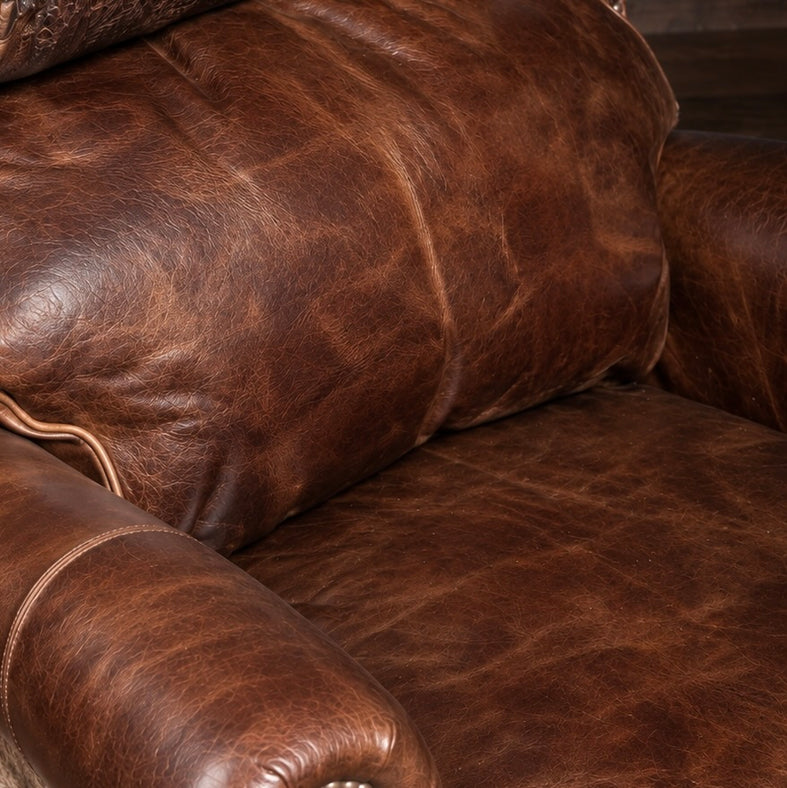
Customers may mistake natural markings such as healed scars, scratches, wrinkles, stretch marks, insect bites, or variations in colour and texture for damage. These are natural characteristics of genuine leather and are often more noticeable in full-grain and distressed leathers. Rather than being defects, they give each hide its own character and appearance.
Normal. Leave it alone.
- Grain variation across a single panel
- Healed scars, insect bites, and range marks
- Colour variation between hides and panels
- Wrinkles and stretch marks
- Pull-up lightening where the leather flexes
- Softening and relaxing with use
- Mild surface marking that buffs out
- Deepening patina at contact points
Not patina. Get it looked at.
- Deep cracking in the grain
- Finish peeling or flaking away
- Severe abrasion through the surface
- Open or pulling seams
- Significant dye loss in patches
- Persistent tackiness after cleaning
- Hair loss or bald patches on hide
- Structural movement in the frame
Can Scratches Make Western Leather Look Better?
On some leathers, genuinely yes. Pull-up and distressed leathers are designed so that flexing and marking lighten the surface and build character, and a scratch on that kind of leather often blends within weeks or buffs out under a fingertip. Full-grain aniline behaves similarly, gaining depth as it marks.
On protected or pigmented leather it is the opposite. There the surface is a finish layer, and a scratch that breaks it is damage rather than character because the finish will not heal. The distinction is not the scratch. It is which leather took it.
Hard Rules
What You Should Never Use on Fine Leather Furniture
Harsh Household Cleaners
Bleach, ammonia, all-purpose sprays, and disinfectant wipes. These strip the finish and dry the leather, and drying is what leads to the cracking people then try to fix with conditioner.
Solvents and Aggressive Stain Removers
Alcohol, acetone, nail polish remover, hairspray, and the improvised ink removers that circulate online. Unless a product is specifically approved for your exact finish, assume it removes finish along with the stain.
This includes hair-on hide. Some older product listings mention water-free solvents or dry-cleaning products, but that is not our recommendation. Avoid cleaning hair-on hide unless it is genuinely necessary, and where it is, spot-clean the affected area with a damp cloth only.
Abrasive Tools
Melamine foam erasers, stiff brushes, scouring pads, and aggressive scrubbing of any kind. Melamine erasers in particular work by abrasion, which on leather means sanding the finish off.
Improvised Conditioners
Olive oil, coconut oil, baby oil, saddle soap, and furniture polish. Household oils do not absorb the way leather conditioner does; they sit in the surface, go rancid, attract dust, and darken the leather permanently.
Excess Water, Steam, and Direct Heat
Steam cleaners, saturated cloths, hairdryers, and drying a damp piece near a fire or vent. Water that soaks in stiffens leather as it dries, and forced heat accelerates exactly the damage you are trying to avoid.
Repair & Restoration
When Leather Furniture Should Be Professionally Restored
Runyon's recommends contacting a professional for deep tears, peeling, large or stubborn stains, and any damage caused by chemicals. Aggressive cleaning or DIY repair on these can cause further damage.
Often improvable at home
- Light surface scratches on distressed leather
- Everyday dust and light soiling
- Dryness caught early, on conditionable leather
- Minor scuffing that buffs out
- Fresh spills blotted immediately
Needs professional assessment
- Cuts, punctures, and deep tears
- Deep cracking or peeling finish
- Significant oil or body-oil staining
- Open or failing seams
- Major colour loss
- Any damage from chemicals
- Hair-on-hide damage or hair loss
- Staining on specialty hides or suede
What We Can Send You
We keep leather care kits for minor maintenance and touch-ups. They are not sold on the website and are not included automatically with an order, but we will send one on request, matched to the leather on your piece.
For more serious damage, including scratches, colour loss, worn areas, stains, and finish damage, we can arrange for a professional furniture repair technician to assess and repair the piece.
What the Warranty Does and Does Not Cover
Runyon's lifetime warranty covers frames and construction. It does not cover the condition of the leather. Wear, and damage caused by improper cleaning or care, fall outside it, which is the practical reason to ask before treating something rather than after.
If You Are Not Sure Which It Is
If you are unsure whether something is a maintenance question or a repair question, ask before treating it. That single call is the cheapest step in this entire guide, and it is far easier to advise on intact leather than to correct a well-intentioned attempt.
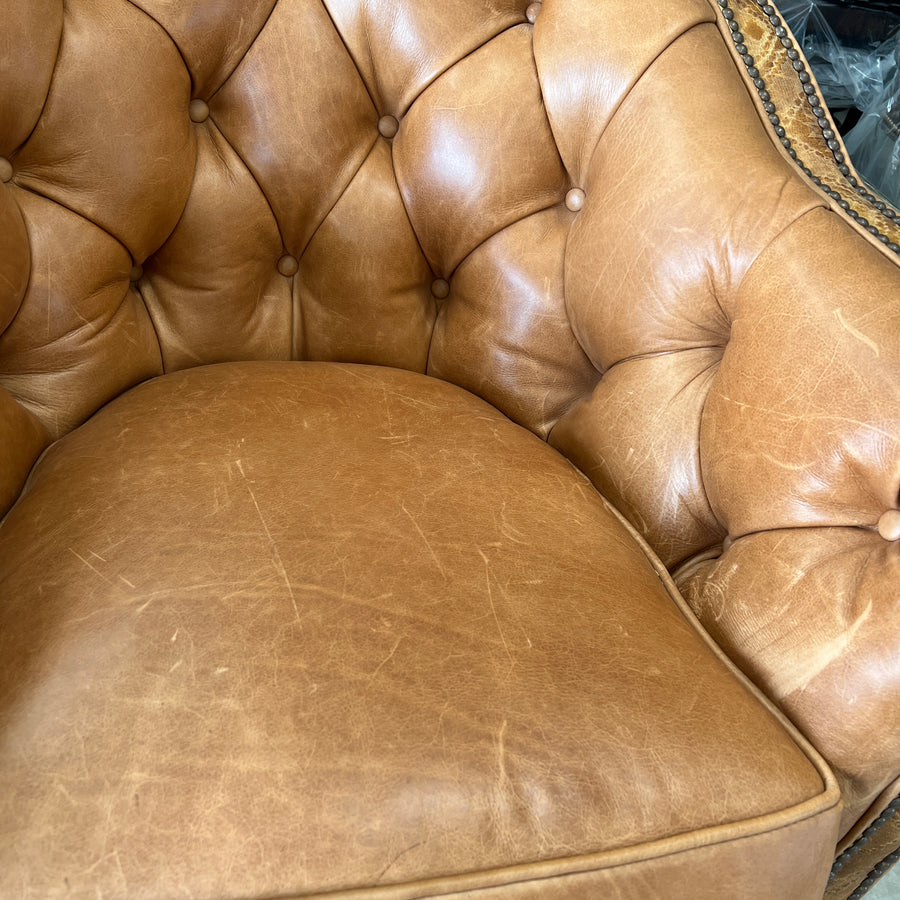
A Touch-Up Our Team Carried Out
Surface scratching across the seat of a tan tufted chair, before and after our service team worked on it. Nothing about the leather was replaced.

If You Remember Nothing Else
Three Rules for Decades of Good Leather
Use the Right Products
Clean and condition only with products recommended for your specific type of leather. This one rule prevents most of the damage we are asked to repair.
Protect It From Everyday Damage
Keep it out of direct sunlight and away from excessive heat, and be mindful of pets, claws, buckles, rivets, and anything that could scratch or puncture the leather.
Stay Ahead of Wear
Clean spills promptly, keep up with routine care, and contact a professional for more serious damage instead of escalating your own attempts.
Straight Answers
Frequently Asked Questions
How often should leather furniture be conditioned?
What is the safest way to clean leather furniture?
Can you use soap and water on leather furniture?
What causes leather furniture to crack?
Can sunlight damage leather furniture?
How do you remove body oils from leather furniture?
How do you care for cowhide furniture?
Can leather conditioner be used on hair-on-hide?
Can scratches in leather furniture be repaired?
When should leather furniture be professionally restored?
Not Sure What You Have?
Send Us a Photograph Before You Treat It
Tell us the piece and what you are seeing, and we will tell you what the material is and what it needs. It is far easier to advise on intact leather than to correct a well-intentioned attempt.
Built to Be Lived With
Leather That Is Cared For Gets Better, Not Older
Runyon's builds with genuine full-grain and top-grain leathers, hand-selected hides, and solid hardwood frames, because those are the materials that reward being looked after. Cared for properly, a Runyon's piece does not simply survive decades of use. It earns its character over them.
Ask About Care for Your Piece