Western Interiors

The Complete Luxury Ranch
Interior Design Guide

A complete guide to designing timeless Western living spaces with handcrafted furniture, natural materials, and authentic ranch style. Room by room, from the designers who build it.

The Short Answer

What Is a Luxury Ranch Interior?

What Is a Luxury Ranch Interior?

A luxury ranch interior is a Western-rooted design approach built on authentic natural materials, handcrafted furniture, and generous scale. Full-grain leather, solid hardwood, iron, stone, wool, and genuine hide, layered so a room feels warm, textured, and lived-in.

What separates it from farmhouse or generic rustic style is substance rather than motif. Farmhouse leans on painted finishes, whitewashed neutrals, and decorative references. Generic Western leans on applied ornament: stars, horseshoes, lettering. A luxury ranch interior builds its character into the piece itself, through hand-tooled leather, hand-carved wood, nailhead trim, hide upholstery, and frames made to last generations rather than seasons.

The goal is never a "ranch look." It is a home that feels authentic, warm, and deeply personal, designed to feel as though it evolved naturally over time rather than being decorated all at once.

Element Farmhouse / Generic Western Luxury Ranch
Materials Veneer, MDF, faux-distressed paint, printed upholstery made to imitate leather. Full-grain and top-grain leather, solid hardwood, iron, stone, wool, genuine hide.
Western character Applied as decoration: stars, horseshoes, lettering, signage. Built into the piece: hand-tooling, carving, nailhead, hide, stitch detail.
Scale Standard catalog dimensions sized for an average room. Scaled to the actual room, with extended depths, longer tables, taller headboards.
Palette Whitewash and gray-wash neutrals, or head-to-toe brown. Layered earth tones with depth: saddle, cognac, bone, iron, considered accent color.
How it ages Wears out and gets replaced in five to ten years. Develops patina and character; lifetime warranty on frames and construction.
Runyon's pieces aren't designed around a trend. They're rooted in the values of Western living: authenticity, individuality, enduring craftsmanship, and a deep appreciation for natural materials.

Start Here

Finding Your Style

Most clients arrive knowing the feeling they want before they know the name for it. These four directions cover the range we design in most often. You don't have to pick one and stay in it, but knowing where you lean makes every decision after this one easier.

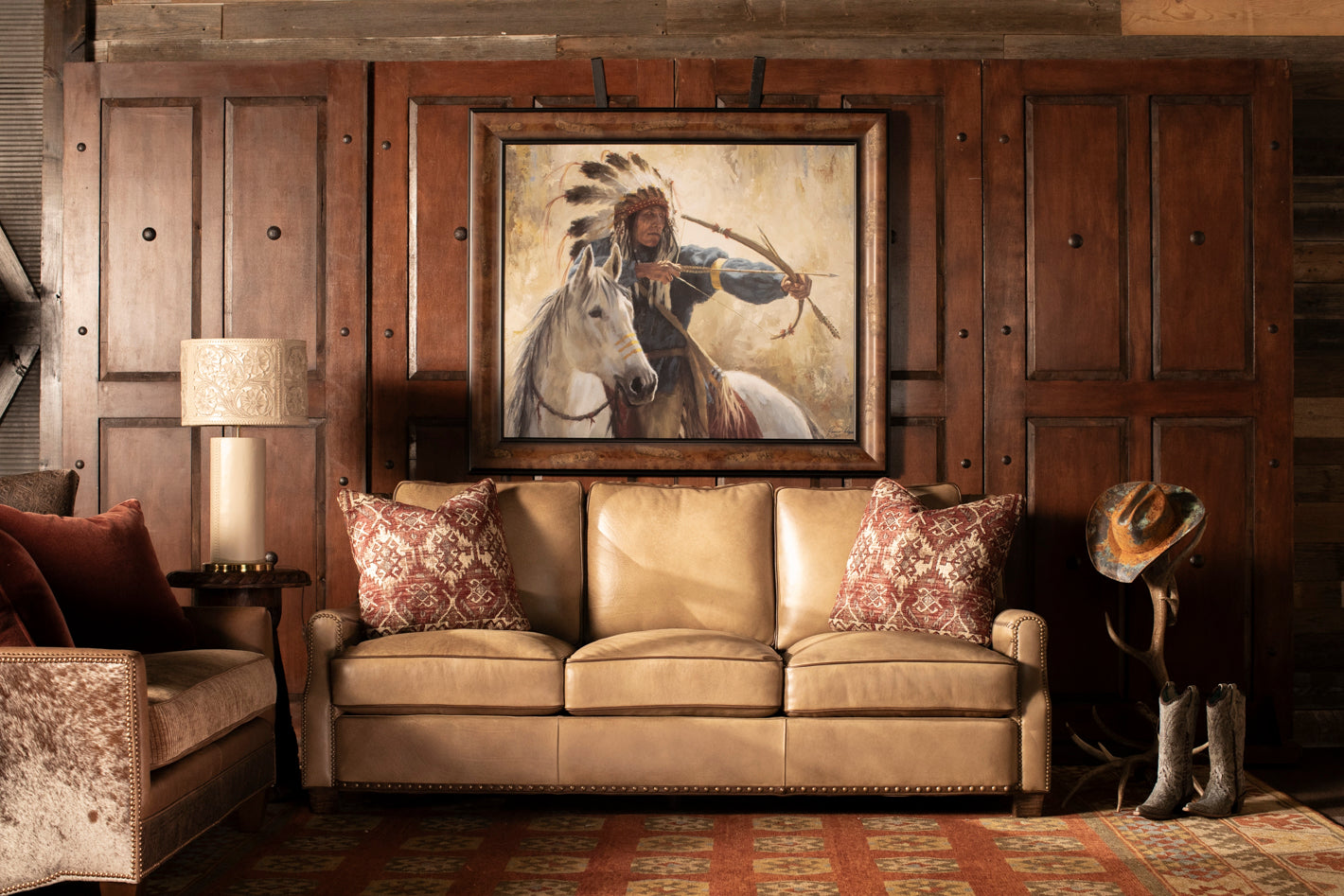
Traditional Western living room with tufted leather chair, ottoman, Western oil painting, and patterned area rug

Traditional Western

The most recognizable of the four, and the most detailed. Hand-tooled leather, cowboy and longhorn motifs, nailhead trim, carved wood, and warm earth tones in saddle, cognac, oxblood, and bone. Rooms are richly layered and unapologetically Western, with wall art and accents that carry real narrative weight. Best suited to homes with wood panelling, exposed beams, or heavy architectural character to match.

Shop the Western Heritage Look →
Modern ranch living room with clean-lined cream leather sofa, neutral palette, and restrained Western accents

Modern Ranch

Western materials without the ornamentation. Clean-lined frames, neutral and tonal palettes, minimal nailhead, and hide used as an accent rather than a statement. The craftsmanship and the leather still do the talking. There's just less visual noise around them. This is the right direction for newer builds, open floor plans, and anyone who wants Western character without theming the house.

Shop Modern Ranch →
Safari luxe room scene with axis deer hide chairs, hide-topped ottoman, cowhide rug, and carved wood buffet

Safari Luxe

Where Western meets global. Exotic hides paired with bold texture, dark woods, and collected-over-time detail: axis deer, springbok, buffalo, and Tibetan lamb, alongside croc-embossed leathers. It's the most dramatic of the four and rewards restraint elsewhere: let the hides carry the room and keep walls, rugs, and case goods quiet. Ideal for studies, lounges, trophy rooms, and anyone drawn to pieces no one else will have.

Shop the Exotic Collection →
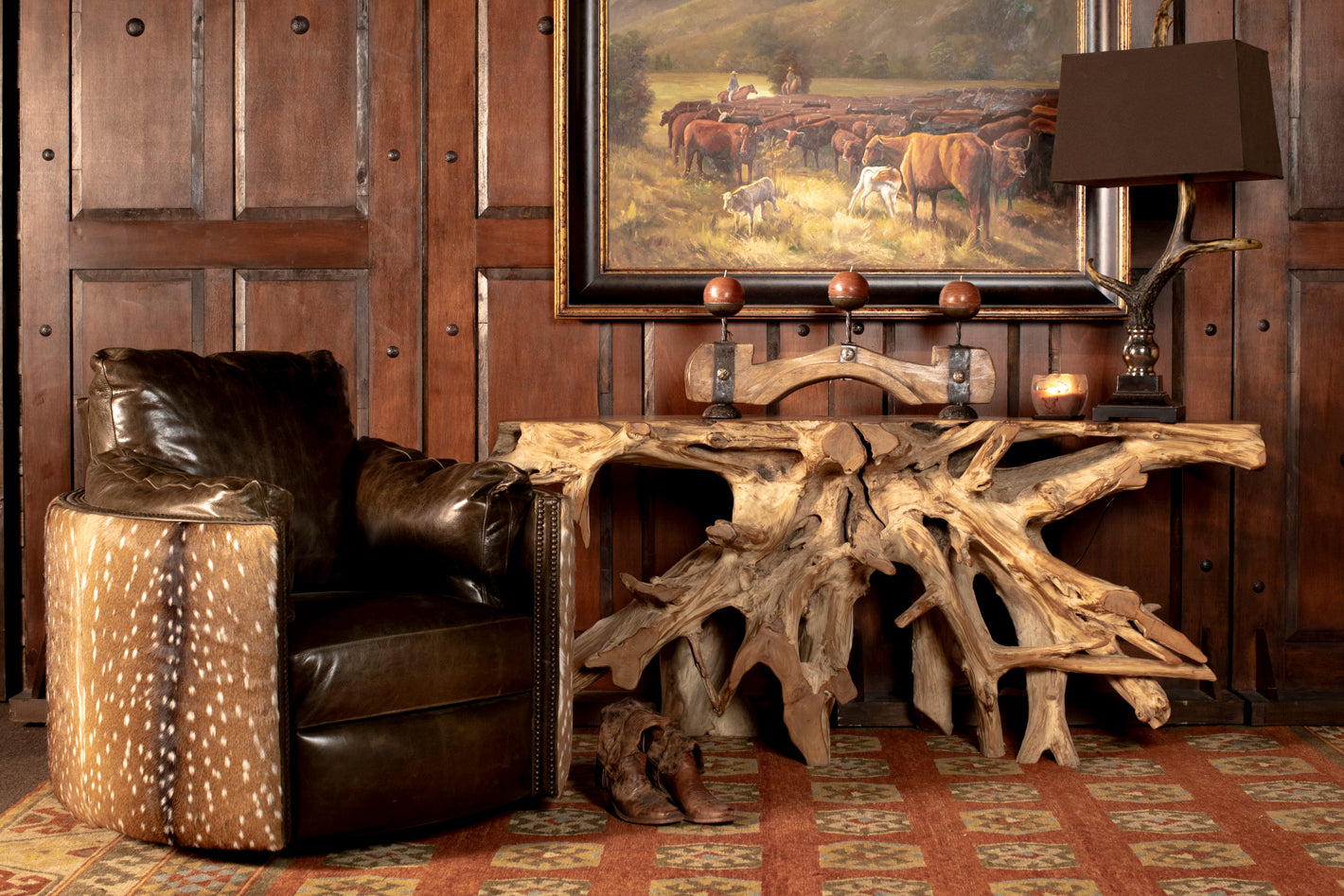
Rustic lodge interior with distressed leather recliner, longhorn wall art, and reclaimed driftwood console table

Rustic Lodge

Mountain cabin warmth. Reclaimed wood with visible age and saw marks, antler lighting, iron hardware, wool textiles, and deep distressed leathers. Palettes run darker and cooler than traditional Western, closer to forest, stone, and smoke than desert. This direction is built for homes with real timber and stone in the architecture, and it's the most forgiving of heavy daily use.

Shop the Reclaimed Wood Collection →
Still deciding?

Walk through complete rooms we've styled, then borrow what works for yours.

Design Principles

The Foundations of Luxury Ranch Design

Three principles apply no matter which direction you chose above. Get these right and almost any combination of pieces will work together. Get them wrong and even the best furniture in the house won't save the room.

Materials

Natural Materials Age. Synthetics Just Wear Out.

This is the difference you feel in year seven, not on delivery day. Full-grain leather darkens, softens, and takes on the shape of how you sit in it. Solid hardwood picks up a patina at the edges where hands land. Iron dulls. Wool relaxes. Every one of those changes reads as character.

Bonded leather, veneer, and printed upholstery do the opposite. They crack, peel, and delaminate, and there's no repairing them. At this level of investment, authentic material isn't a luxury detail. It's the entire reason the piece is still worth having in twenty years. Runyon's uses genuine full-grain and top-grain hides from tanneries in Italy and Brazil, and hardwoods from furniture-grade mills. Learn more in our Leather Types Guide.

Scale

Scale and Proportion — Go Bigger Than You Think

Ranch homes are built with volume: high ceilings, exposed beams, oversized fireplaces, wide great rooms. Standard-depth furniture floats in that kind of space and makes the room read unfinished. Oversized pieces don't crowd a ranch room. They give it a floor.

The counterbalance is breathing space. Choose one genuine statement piece per room and let everything else stay quieter and lower. Leave real walking room around seating, and resist filling every corner. A large room with three substantial pieces and open floor reads far more expensive than the same room with nine medium ones.

Texture

Texture and Warmth Without the Clutter

Depth in a Western room comes from surface variety, not from quantity of objects. The working method is to layer four material families in every room, hide, wood, leather, and metal, letting each one appear at a different scale.

A smooth top-grain sofa next to a hair-on hide chair, a hand-carved table beside blackened iron lighting, a wool rug underneath all of it. Same palette, four completely different ways light hits the room. That's what makes a space feel rich. Adding a tenth decorative object does not. It just makes it busy.

"The most cohesive spaces layer leather, wood, and metal intentionally, balancing a bold statement piece with quieter supporting pieces, rather than letting every item compete for attention. It's the difference between a room full of Western pieces and a room that feels like one complete story."

— Runyon's Design Team
Layered Western vignette with distressed leather recliner, axis hide ottoman, reclaimed driftwood console, and oil painting
Four materials. One palette.
Turquoise and bronze patterned chaise lounge with nailhead trim, Tibetan lamb pillow, and longhorn skull wall mount
Texture does the work.

Room by Room — 01

The Living Room

Start here. The living room is the heart of the home, and the piece you choose first, almost always the seating, sets the material language every other room will answer to. Get the anchor right and the rest of the house gets easier.

Saddle-tan tufted leather sofa and matching wing chair against a deep blue panelled wall, with an iron side table and lamp
Living Room — The Saddle Club Look Shop This Room →
The Anchor

Anchoring the Room — Sofas and Sectionals

The choice between a sofa and a sectional comes down to how the room is shaped and how it's used. A sofa gives you a symmetrical, formal arrangement and works best when the room has a clear focal wall, a fireplace or a large piece of art, with seating facing it. A sectional is the better answer for open-concept great rooms and for families who actually pile onto the furniture, and it doubles as a soft boundary between zones.

At this price point, look past the surface. You want a solid hardwood frame, eight-way hand-tied or comparable suspension, and genuine full-grain or top-grain leather, wrapping the back and sides, not just the seating surface. Ask about seat depth before ordering; we routinely extend it four to six inches for taller clients.

Browse Western leather sofas and Western sectionals.

Secondary Seating

Layering Seating — Accent Chairs, Swivels, and Recliners

A room with only a sofa looks staged. Secondary seating is what makes it feel lived-in, and it's the best place in the house to introduce a second material. If the sofa is smooth leather, this is where hide, embossed leather, or a woven textile earns its place.

Accent chairs in a contrasting hide or color do the most visual work per dollar. Swivel chairs are the practical choice in open plans, where seating needs to turn toward the TV, the fireplace, or the kitchen without being rearranged. Leather recliners belong in the spot someone actually claims every evening, and modern mechanisms hide inside frames that no longer announce themselves as recliners.

Two chairs flanking a fireplace, or one oversized chair with an ottoman in a corner, both work. A matching set that simply repeats the sofa doesn't.

Surfaces

Tables and Surfaces

Tables are where wood becomes the subject rather than the support. A coffee table in reclaimed timber, hand-carved hardwood, or iron-and-wood can carry a room on its own, and in a leather-heavy space, it's the break the eye needs.

Scale it to the seating: roughly two-thirds the length of the sofa, and within an inch or two of seat height. End tables should sit at or just below arm height so a drink lands naturally. Console tables earn their keep twice over: behind a floating sofa they close the back of a seating group, and against a wall they become a display surface for lamps, bronzes, and framed pieces.

Foundation

Choosing the Right Rug

In an open floor plan, the rug is not decoration. It's architecture. It's the single most effective way to define a seating area and create a visual boundary without closing anything off, which is exactly why we start open-concept layouts with rug placement.

Size it generously. The front legs of every seating piece should land on the rug at minimum; all four legs is better in a large room. A rug that floats with furniture stranded around it shrinks the whole space. In Western interiors, wool rugs give you pattern and durability at once, and the flat-woven Soumak collection carries the Southwestern and tribal motifs that suit a ranch room. Hide layered over wool adds a second texture underfoot. For lighter, tonal schemes, see Modern Ranch rugs.

The Finish

Finishing the Room — Lighting, Pillows, and Wall Art

This is the layer most people under-invest in, and it's the one that makes a room look designed rather than furnished. Light the room in three places, not one: a chandelier or fixture overhead, table lamps at seating height, and a floor lamp in a reading corner. Warm bulbs only, since cool light flattens leather and kills wood tone instantly.

Pillows and throws are the cheapest way to add the texture a leather room needs: wool, Tibetan lamb, and woven pattern against smooth hide. Wall art should be scaled to the wall, not the budget: one large piece above the sofa beats four small ones. Browse all Western home decor.

Choosing between leathers for your sofa or chairs?

Full-grain, top-grain, hair-on cowhide, exotic hides. How each one wears, ages, and cleans.

Room by Room — 02

The Dining Room

The table is the anchor here, and it carries more weight than any other single piece in the house. It's where the family actually gathers, and it dictates the scale and finish of everything around it.

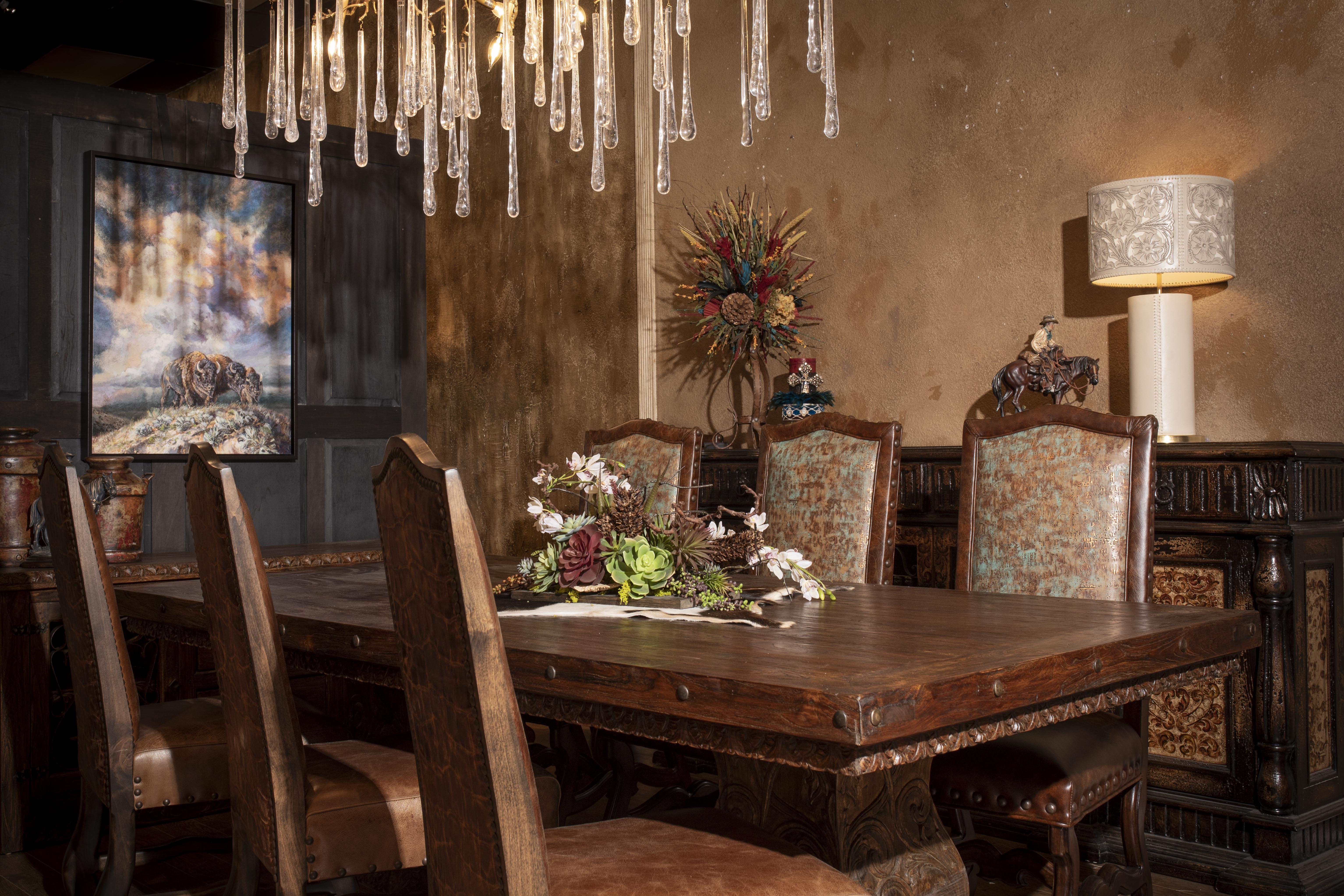
Western dining room with hand-carved reclaimed wood table, tapestry and leather dining chairs, and a crystal drop chandelier
Dining Room — Carved Hardwood & Tapestry Seating Shop This Room →
The Anchor

Choosing the Right Dining Table

Size it by seats and clearance, in that order. Plan on 24 inches of table edge per person and at least 36 inches between the table edge and the nearest wall or buffet so chairs can pull out. In practice: a 72-inch table seats six comfortably, 96 inches seats eight, and seating twelve or more means 120 inches and up.

Wood species sets the tone as much as the silhouette does. Reclaimed oak and mesquite bring visible age, saw marks, and movement. Walnut and teak read more refined and take a smoother finish. Alder and pine accept distressing and custom paint well. Trestle and pedestal bases free up leg room at the ends; a four-leg base is more forgiving under a heavy top.

This is where custom dimensions matter most. Standard catalog lengths rarely fit a real ranch dining room. We build tables to seat sixteen, narrow them for tighter rooms, and adjust height for counter-style seating, all to the inch. Browse Western dining tables.

Seating

Dining Chairs That Set the Tone

Leather chairs are the most durable and the easiest to live with: they wipe clean, they age well, and they suit a formal room. Fabric and tapestry backs bring in pattern and color that leather can't, and they soften a room dominated by heavy wood. Hide-back and hair-on chairs are the most distinctly Western of the three and the most striking in a set of eight or more.

On matching versus mixing: a fully matched set reads formal and intentional. The more interesting move is two captain's chairs at the heads in a different material or color from the side chairs. It gives the table a front and back, and it's the easiest mix to get right. Mixing every chair only works when a single element ties them together, usually the wood finish or the leather color.

Browse Western dining chairs.

Storage

Buffets and Sideboards

A buffet does two jobs at once: it absorbs the serving pieces, linens, and glassware that otherwise live in the kitchen, and it gives the dining room a second visual surface so the table isn't carrying the room alone.

Keep it a few inches shorter than the table's length and leave at least 36 inches of walking clearance behind pulled-out chairs. The top becomes prime display space: a pair of lamps, a bronze, a large mirror or piece of art above it. In carved or hand-painted wood, a buffet is often the piece guests notice first. Browse Western buffets, or see all Western dining room furniture.

Need a table that doesn't exist in a catalog?

Custom lengths, widths, heights, and finishes. See exactly how custom dimensions work.

No Charge, No Obligation

Let a Designer Plan the Room With You

Our design consultations are complimentary, whether in-store, in-home, or virtual. Bring your floor plan and a few photos, and we'll build the room around the way you actually live.

Room by Room — 03

The Bedroom

The bed is the anchor, specifically the headboard. It's the first thing you see when you walk in, and it sets the tone for the whole space. Everything else in the room supports it.

Western bedroom with a carved wood and wrought iron bed, matching nightstands, antler chandelier, and layered bedding
Bedroom — Carved Wood & Iron Bed Shop This Room →
The Anchor

The Bed as a Statement Piece

Bedrooms give you more vertical room to work with than any other space in the house, and a tall headboard is the cheapest way to make a bedroom feel finished. Under nine-foot ceilings and above, a low platform bed will always read as unfinished.

Leather headboards, whether tufted, channel-stitched, or plain with nailhead, bring softness and a quieter kind of luxury, and they're the more comfortable choice if you read in bed. Carved wood and wrought iron frames are the more architectural option: they hold their own against heavy panelling and timber, and they carry the most Western character. Reclaimed timber frames land between the two, bringing texture without ornament.

Browse Western beds and wooden beds.

Storage

Storage With Style — Dressers, Chests, and Nightstands

A fully matched bedroom set is the safe choice, and in a large primary suite it can read as intentional and calm. But the more designed approach is to match the pair and vary the rest: keep the two nightstands identical for symmetry, then let the dresser or chest be a different but related piece.

What holds a curated mix together is one repeated element. Usually that's the wood tone or the hardware finish; sometimes it's a carving motif or a shared leather color. Practical notes: nightstands should sit within a few inches of mattress height, a chest of drawers uses vertical space better than a dresser in a narrow room, and a tall chest gives you a second display surface at eye level.

See all Western bedroom furniture.

Atmosphere

Comfort and Atmosphere — Benches, Bedding, and Lighting

A bench at the foot of the bed is the most underrated piece in the room. It finishes the composition visually, gives the bed a base, and it's where everything actually lands at the end of the day. In leather or hide, it's also a chance to repeat a material from elsewhere in the house.

Layer the bedding with a quilt or coverlet, a folded throw, and pillows in three depths rather than one flat row. Wool, Tibetan lamb, hide, and woven textiles against smooth cotton is what makes a bed look photographed rather than made.

For lighting, put it at three heights: overhead for the room, bedside table lamps tall enough to read by with the shade bottom near eye level when you're sitting up, and something low and warm elsewhere. Bedrooms are the one room where every fixture should be dimmable.

Every piece arrives via our white-glove delivery service, carried in, unpacked, assembled, and placed exactly where you want it, with all packaging removed. Learn how delivery works →

Room by Room — 04

The Home Office

The most overlooked room in the ranch home, and the one where authentic furniture makes the sharpest difference. An office built from real wood and leather is a room you want to work in, not a corner with a desk in it.

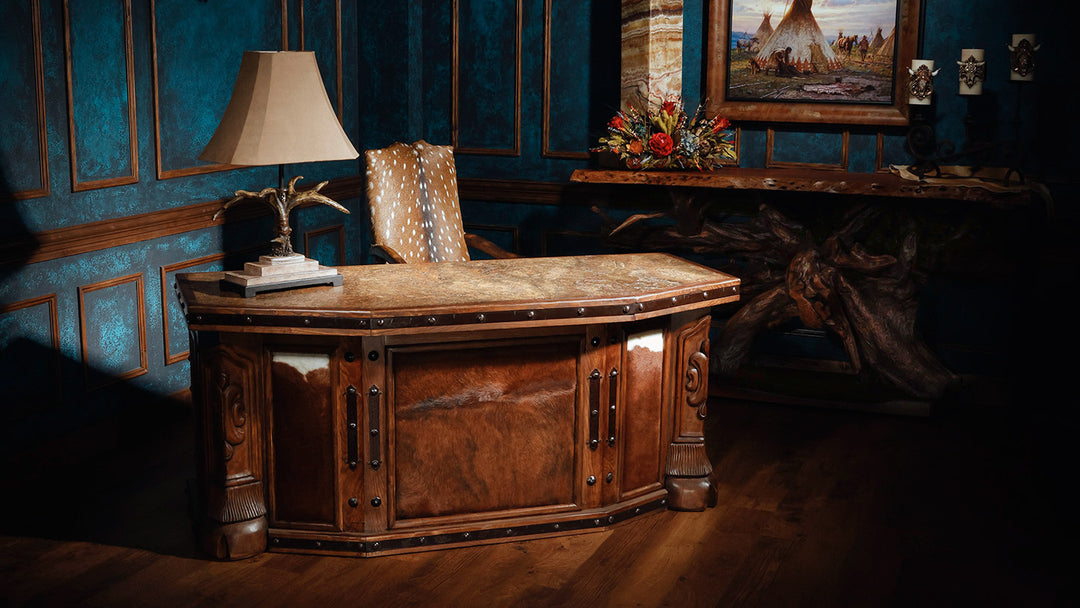
Western home office with a leather-wrapped executive desk, nailhead trim, table lamp, and framed Western oil painting
Home Office — Leather-Wrapped Executive Desk Shop This Room →
The Anchor

The Executive Desk

The first decision is writing desk or executive desk, and it comes down to whether the desk needs to float. A writing desk is lighter, open underneath, and finished on all four sides, making it the right choice for a smaller room or a desk placed in front of a window or in the middle of the floor. An executive desk is larger, pedestal-based, and built for storage and presence, meant to be worked at from one side with the room arranged around it.

In Western offices the material combination is what elevates it: hand-carved hardwood with a leather-wrapped or inset top, nailhead trim along the edges, and iron hardware. A leather top is also the more practical surface, warmer under your forearms than stone, quieter than wood, and it patinas rather than scratching. Browse Western office desks.

Seating

Desk Chairs Built for Long Days

A generic office chair is engineered to be replaced. Mesh sags, foam compresses, plastic bases crack, and the whole thing looks wrong in a room built from hardwood and hide.

A Western leather desk chair is built the way the rest of the house is: a hardwood frame, genuine top-grain or full-grain leather, and often hand-tooling, quilting, or nailhead detail, usually on a modern swivel-tilt mechanism with casters, so you get contemporary function inside a frame that belongs in the room. Leather also breathes better than mesh over a long day and softens to your shape instead of flattening out.

If the office doubles as a sitting room, add a leather accent chair opposite the desk. Browse Western office chairs.

Walls

Bookcases, Hutches, and Wall Units

Vertical storage is what turns a desk in a room into an office. Bookcases in matched pairs flanking a window or doorway create instant symmetry; run them floor to ceiling along one wall and you have a library wall, which is the single best backdrop a Western office can have.

Hutches and wall units solve the problem bookcases don't: they hide the equipment. Closed lower cabinets absorb printers, files, and cable runs while glass or open upper sections stay available for books, bronzes, and framed pieces. Mix roughly two-thirds closed storage to one-third display and the room stays sharp even on a working day.

See all Western office furniture.

Every piece on this page is fully customizable.

Dimensions, leather, wood species, stain, hardware, and finish, all built to your specification.

Room by Room — 05

The Bar and Entertainment Room

This is the room built for other people. It takes the hardest use in the house, which makes material choice less about looks and more about performance. And it's where Western character can go furthest.

Western sports bar with a full row of custom leather and cowhide bar stools, built by Runyon's Fine Furniture
Bar & Lounge — Custom Western Bar Seating Shop This Room →
Seating

Bar Stools — Saddle, Swivel, and Counter Height

Get the height right first, because nothing else fixes it. Counter height stools run 24–26 inches for a standard 36-inch kitchen counter. Bar height stools run 29–32 inches for a 42-inch bar. Leave roughly 10–12 inches between the seat and the underside of the counter, and plan 26–30 inches of counter width per stool.

Saddle stools are the signature Western choice: a contoured seat shaped like a saddle, usually backless, which keeps sightlines open and lets stools tuck fully under an island. Backless is the better look; it's the worse choice for long sitting. Swivel and back-style stools are what you want in a real entertaining room, where people sit for hours and turn to talk. A 360-degree swivel is worth specifying every time.

Browse all Western bar furniture.

Tables

Game Tables and Pub Tables

Both need more floor than people expect. A poker or game table seating eight wants a minimum of 12 by 12 feet of clear floor to allow chairs to push back and someone to walk behind them. Look for a padded leather or suede rail, individual drink recesses, and a reversible or removable top so the table works for dining and cards both.

Pub tables are the better answer for a smaller lounge or a corner. At bar height with two to four stools, they read as a standing-and-talking spot rather than a dining set, and they fit where a full table can't. In a large room, one game table plus a pub table in the corner gives you two distinct destinations instead of one crowded center.

The Finish

Game Chairs and Lounge Seating

Leather game chairs are the finishing piece, and they're worth spending on for one reason: they're the only seat in the house someone occupies for four hours without moving. Look for a supportive seat, arms low enough to sit under a table rail, and casters or a swivel so a player can move without standing.

They're also the natural place for the boldest material in the house. Croc-embossed leather, hair-on hide, and mixed-material backs all work here in a way they wouldn't in a formal dining room. Round the room out with a chaise or a pair of swivel chairs pulled away from the table, so people who aren't playing still have somewhere to sit. See all Western game room furniture.

Room by Room — 06

The Entryway

Western entryway with a hand-carved console table, red leather accent chair, bronze sculpture, framed art, and cowhide rug

Creating a Strong First Impression

The entryway is the smallest room in the house and it does the most work. It is the first thing guests see, and it tells them what the rest of the home is going to be. That makes it the one room where the job is to preview rather than introduce. Every material and tone here should already exist somewhere else in the house.

Three pieces carry an entry. A console table against the wall gives you a landing surface and the room's strongest opportunity for hand-carved wood or reclaimed timber. Scale it to roughly two-thirds the width of the wall it sits on, and keep it shallow, around 14 to 18 inches deep, so it never narrows the walkway.

A mirror above the console does two jobs at once. It bounces light back into what is usually the darkest part of the house, and it makes a narrow entry read considerably wider. Hang it so there are four to six inches between the console top and the frame, and keep the mirror narrower than the console so the pair reads as one composition.

Then lighting, which sets the temperature of the entire arrival. A chandelier suits a two-story entry and should hang with its lowest point at least seven feet above the floor. In a single-story entry, a pair of table lamps on the console gives you warmer, lower light that flatters leather and carved wood far better than an overhead fixture alone.

From there, add only what the floor can carry. A bench or a single accent chair if there is genuine room for it, a hide or wool runner underfoot to warm hard flooring and absorb sound, and one piece of art or a bronze with real presence rather than a cluster of small objects. In a working ranch entry where coats, hats, and boots actually need somewhere to go, a hall tree is the honest answer and belongs there.

The mistake to avoid is treating the entry as leftover space and filling it with whatever did not fit elsewhere. It is the shortest room to get right and the one that colors how everything after it is read.

Browse Western entryway furniture.

Room by Room, or All at Once

See Complete Rooms Before You Commit

Our Room Scenes let you walk through finished spaces, every piece shoppable, so you can see how leather, wood, and texture come together before you choose a single item.

By Home Type

Choosing Furniture for Your Type of Home

Our design philosophy doesn't change from house to house, but how a home will actually be lived in changes what we prioritize. Here's what shifts.

Open Concept Ranch Homes

In an open plan we're not trying to divide the room. We're creating distinct destinations within it while keeping the whole space connected. Area rugs do most of that work, anchoring a seating area and drawing a visual boundary without closing anything off.

From there it's placement. Float a sofa to separate the living area from the walkway, back it with a console, angle chairs to encourage conversation, and use case goods to guide how people move through. Done well, an open home doesn't read as one large room. It reads as a collection of spaces that flow together.

Mountain Lodges and Cabins

Lodges tend to run tall and narrow rather than wide, with soaring ceilings over a modest footprint. That calls for pieces with vertical presence: tall headboards, floor-to-ceiling wall units, and chandeliers hung low enough to bring the ceiling back down into the room.

Palettes go darker and cooler, materials get heavier, and reclaimed wood, antler lighting, iron, and wool carry the aesthetic. Measure stairwells and doorways before ordering, since cabin access is the most common constraint we design around.

Texas Ranch Homes

What we see most from clients across DFW and North Texas: expansive great rooms, soaring ceilings, exposed beams, oversized fireplaces, and open floor plans. Furnishing those spaces isn't about filling them. It's about creating balance.

Thoughtfully scaled furniture, authentic materials, and intentional layouts are what make a very large room feel warm and comfortable while still honoring the architecture. This is where custom dimensions earn their keep, and where our Roanoke showroom is worth the drive, because scale is difficult to judge from photographs.

Barndominiums and Post-Frame Homes

A steel or post-frame shell gives you enormous uninterrupted span, high ceilings, and almost no interior walls, which means very few architectural cues telling the furniture where to go. Stained concrete floors and metal surfaces also leave the space acoustically hard and visually cool.

Both problems share one answer: soft, oversized, and layered. Sectionals and consoles become the walls you don't have, wool rugs define zones and absorb echo, and reclaimed wood and full-grain leather bring warmth back to a shell built from steel.

Luxury Vacation Homes

A second home in Colorado, Montana, or Wyoming is usually centered on hosting, so the priorities shift toward shared spaces, flexible seating, and materials that hold up to a house full of guests. There's also a stronger connection to the landscape; the design often leans into the setting, so the interior feels like an extension of the land around it.

Nearly all of this work happens remotely. Our virtual design consultation starts before we ever meet: we ask for floor plans, dimensions, photos, and inspiration images, then develop mood boards, palettes, and material selections, with physical swatches mailed to you for approval.

Modern Ranch Interiors

The goal here is going Western without going theme park, and the rule is simple: let the materials be Western and keep the forms quiet. Full-grain leather on a clean-lined frame, solid hardwood with a simple edge, one hide chair instead of four.

Skip the applied motifs, the stars, the lettering, the horseshoes, and let craftsmanship carry the character instead. Our Modern Ranch Collection is built for exactly this, and the Modern Ranch room scenes show how restrained it can look while still reading unmistakably Western.

Whole-Home Flow

Bringing the Entire Home Together

We don't approach a home room by room. We approach it as one complete environment, where every material, finish, and furnishing contributes to a cohesive whole. Four decisions carry that continuity from room to room.

Matching Woods Across Rooms

Match within a room, contrast between rooms. Inside a single space, wood tones should be close enough to read as deliberate: a dining table and buffet within a shade or two of each other. Across the house, exact matching flattens everything and starts to feel like a showroom floor.

The reliable approach is one dominant species carried through the home, with a secondary tone that appears in two or three rooms. A dark carved hardwood as the primary, reclaimed oak as the secondary, repeated deliberately, not sprinkled.

Balancing Leather Colors

Rather than matching leather colors exactly, establish a cohesive palette and layer complementary tones throughout. Pick a dominant leather family such as saddle, cognac, chocolate, or bone, and let each room use a different value within it.

Then give yourself one accent leather that shows up in two or three rooms: an oxblood chair in the living room, the same oxblood on the office desk chair. That single repetition does more for whole-home cohesion than matching every sofa would.

Repeating Metals and Hardware

Pick a lane and carry it through. Iron reads rustic and works hardest with reclaimed wood and lodge palettes. Brass and bronze read refined and warm up dark hardwoods. Copper sits between them and patinas beautifully. Nickel and chrome almost never belong in a Western home.

Choose one primary metal for hardware, nailhead, and lighting across the whole house, then allow a second as an accent. Mixing more than two finishes is the fastest way to make a well-furnished home feel accidental.

Color Palette Continuity

Wall tones should stay in one family across connected spaces. That's what lets adjacent rooms read as one home rather than a series of decisions. Keep the walls quiet and let leather, wood, and textiles supply the depth.

Then carry one accent color through the house in small doses: turquoise, oxblood, saddle, or sage, appearing in pillows, rugs, and art in three or four rooms. Not in every room, and never as the dominant tone.

Close-up of hand-carved hardwood scrollwork detail on a Runyon's furniture piece

"Rather than matching leather colors or wood tones exactly, we establish a cohesive palette and thoughtfully layer complementary materials throughout the home. Every room doesn't need to match, but every room should belong."

— Runyon's Design Team

What to Avoid

Common Mistakes When Designing a Ranch Interior

There's no wrong way to bring Western style into a home, since every piece someone chooses reflects who they are. Where homes go sideways is in how those pieces are combined. These are the five we're asked to fix most often.

Buying Everything From One Collection

Ordering a matched suite is the fastest way to furnish a room and the fastest way to make it look like a display floor. When every piece shares the same wood, the same leather, and the same detailing, there is nothing for the eye to move between. The room reads flat no matter how good the individual pieces are.

Use a collection as a spine, not the whole skeleton. Take the anchor piece and one companion from it, then bring in a chair, a table, or a case good that relates without repeating. A home should feel as though it evolved over time rather than being decorated all at once.

Choosing Furniture That's Too Small

This is the single most common mistake in ranch homes, and it's almost always a measuring problem rather than a taste problem. People shop by comparing a piece to their current furniture instead of to the room's actual volume, and a great room with fourteen-foot ceilings will make standard-scale furniture look like it wandered in from somewhere else.

Tape the footprint out on the floor before you order. Then go one size up from what feels right. Undersized furniture in a large room doesn't read as restrained. It reads as unfinished.

Using Faux Rustic Materials

Printed woodgrain, bonded leather, and factory-distressed paint all photograph convincingly and fail in person. The tell is uniformity: real wood grain wanders and real hide carries the animal's history, while a printed pattern repeats. Under warm ranch lighting, that repetition is obvious.

More importantly, they age in the wrong direction. Genuine leather and solid hardwood get better with use; bonded leather cracks and peels within a few years and cannot be repaired. In a Western interior, where texture and patina are the aesthetic, synthetic materials undercut the entire point of the room.

Ignoring Lighting

Beautiful furniture in bad light looks like ordinary furniture. Rich leathers and hardwood finishes depend entirely on how they're lit, and a single overhead fixture with cool-toned bulbs will flatten the most expensive room in the house into something gray and shadowless.

Light every room at three heights: overhead, at seating level, and low. Use warm bulbs throughout, put the main fixtures on dimmers, and add sconces or lamps wherever there's leather or carved wood you actually want people to notice. Lighting is not the last thing you buy. It's what determines whether everything else was worth buying.

Not Planning the Room Around One Statement Piece

When every piece in a room is trying to be the most interesting one, none of them are. A hand-tooled sofa, a carved buffet, a hide chair, an antler chandelier, and a bold rug can each be exceptional and still add up to a room that feels loud and unresolved.

Choose the anchor first, then deliberately quiet everything else down. Supporting pieces should share the palette and step back in detail: simpler lines, less ornament, calmer surfaces. That restraint is precisely what makes the statement piece land, and it's the difference between a room full of Western pieces and a room that feels like one complete story.

What Clients Ask Us

Frequently Asked Questions

Can Western furniture work in a modern home?

Yes, provided you choose pieces for their material and craftsmanship rather than their ornamentation. A full-grain leather sofa with a clean profile, a solid hardwood table with a simple edge, or a single hide chair reads as sophisticated in a contemporary room. The rule is restraint: let one or two authentic Western pieces carry the character and keep the surrounding palette calm. Our Modern Ranch Collection is built specifically for this, offering Western materials without the heavy detailing.

How much leather is too much?

There's no fixed limit, but a room reads flat when every upholstered surface is the same leather in the same finish. The fix is usually to vary the leather rather than reduce it. Pair a smooth top-grain sofa with a hair-on hide chair, or a distressed recliner with a woven textile ottoman. Then break up the large leather surfaces with wool pillows, a patterned rug, and wood or iron surfaces, so light hits the room differently in each place.

Can I mix reclaimed wood and painted finishes?

Yes, and it usually improves a room. Reclaimed wood brings texture and age; a painted or distressed finish brings contrast and keeps a space from feeling heavy. The key is giving the mix a reason: repeat the painted finish in at least two places so it reads as a deliberate choice rather than a leftover piece. Runyon's builds custom painted and distressed finishes to order, so a painted piece can be matched precisely to the reclaimed wood it sits beside.

Should every room match?

No. Every room doesn't need to match, but every room should belong. Rather than matching leather colors or wood tones exactly, establish a cohesive palette and layer complementary materials throughout the home. Repeating those elements with intention creates continuity, while variation in tone, texture, and scale gives each space its own character. The result is a home that feels layered and authentic rather than overly coordinated.

How do I start furnishing a ranch home from scratch?

Start with the living room, because it's the heart of the home and it sets the tone for everything else. Choose the anchor piece first, usually the sofa or a chair with real presence, since that piece introduces the leather, wood, and texture the rest of the house will echo. Then build outward: rugs and tables in the same room, then the dining room, then bedrooms. Our design consultations are complimentary, in-store, in-home, or virtual.

What's the most important piece to buy first?

The anchor piece for the room you use most. In a living room that's the seating: a sofa or chair with enough presence to introduce the room's materials. In a dining room it's the table, because it carries the most weight and dictates the scale and finish of everything around it. In a bedroom it's the bed, specifically the headboard, since it's the first thing you see when you walk in. Everything else gets chosen to support the anchor, not compete with it.

How do I design a room I've never seen in person?

Our virtual design consultation is built for exactly this. Before we meet, we ask for floor plans, room dimensions, photos of the space, and any inspiration images, so your designer arrives already understanding the home's architecture instead of starting from a blank slate. The consultation itself focuses on how you live and what you want the space to feel like. From there we develop mood boards, color palettes, material selections, sketches, and curated furnishings, and mail physical swatches so every material is approved before production begins.

Can I customize dimensions to fit an unusual space?

Yes. Dimensions are one of the most commonly customized elements at Runyon's. We've extended sofa depths by four to six inches for taller clients, lengthened sofas for oversized great rooms, widened recliner seats, narrowed dining tables for tighter rooms, adjusted table heights, and built dining tables to seat sixteen. Some complex frame profiles can't be altered structurally, and our design team will confirm what's possible for a specific piece before you commit. See our Custom Furniture Process.

Talk It Through

Prefer to Just Ask Someone?

Call or email the design team directly. Tell us the room, the house, and what you're trying to achieve, and we'll tell you honestly what's possible.

One Home, One Vision

Need Help Pulling It All Together?

Every home we design is different, because it reflects the people who live in it. Our design team works with you one-on-one, whether in our Roanoke showroom, in your home, or virtually from anywhere in the country, to layer authentic materials, handcrafted furnishings, and meaningful details into a home that feels like it has always been yours.

Talk to Our Design Team